| Rating: | 5 (1 votes) |
| Played: | 0 times |
| Classification: | Casual Games |
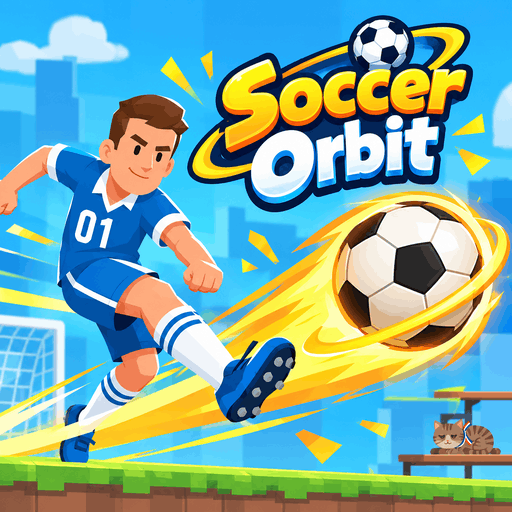
Soccer Orbit looks like a game about kicking hard. You time a swinging arrow, launch a ball past the Paris skyline, and watch the distance counter climb. The obvious instinct is to dump every coin into Strength so your first kick flies farther. That instinct is exactly what keeps most players stuck at mediocre distances.
The real progression in the game is not about how far your first kick travels. It is about how much speed your ball retains after it hits something. That distinction turns Bounce from a secondary stat into the most important early purchase you can make.
Every launch begins with the same ritual: stop the sweeping arrow at the right moment and send the ball into the sky. A perfect strike feels satisfying, and Strength upgrades make that initial burst noticeably faster. But here is what the game does not spell out clearly: the launch is only the opening act. The ball will eventually collide with a planet, an asteroid, or some floating object in its path.
When that collision happens, a low-Bounce ball loses momentum and drops. A high-Bounce ball keeps moving, sometimes redirecting into another celestial body and chaining extra distance from a single kick. This is the interaction most players miss. Strength determines where the ball starts slowing down. Bounce determines whether slowing down matters at all.
New players often hoard coins, waiting for a big Strength upgrade. That patience backfires in Soccer Orbit's early loop. Your coin income is directly tied to distance traveled, which means a weak Bounce stat limits how much you earn per attempt. The slower your progression, the longer you wait for the upgrade you were saving for.
The smarter sequence is counterintuitive: spend your first coins on Bounce, even if your launch power feels underwhelming. A bouncy ball that ricochets off three planets will out-earn a powerful ball that dies on impact. Once your Bounce reaches a comfortable level, Strength and Speed upgrades start compounding on a foundation that actually generates income.
The swinging arrow is not just a power meter. It is a consistency check. Players who chase maximum power every single shot often mistime the release and waste attempts. The game rewards clean launches, not reckless ones.
Experienced players treat the arrow differently. They find a rhythm, release at a repeatable point, and accept slightly lower initial speed in exchange for predictable results. This matters more as your upgrades grow, because a consistent launch lets you actually measure whether your Bounce investment is paying off. A wild launch tells you nothing.
The moment your ball bounces off a planet and keeps flying, Soccer Orbit clicks into focus. You stop viewing each shot as a single kick and start viewing it as a sequence of collisions you can influence through upgrade choices. Bounce is not a passive stat. It is the system that turns a distance game into a chain-reaction game.
Upgrade Bounce first. Time your releases for consistency. Watch your coin income climb as your ball refuses to die on contact. That is when the game stops being a clicking game and becomes a game you are actually playing.
Soccer Kick is the next step worth trying after mastering the power timing of Soccer Orbit.
Casual Gamesonline